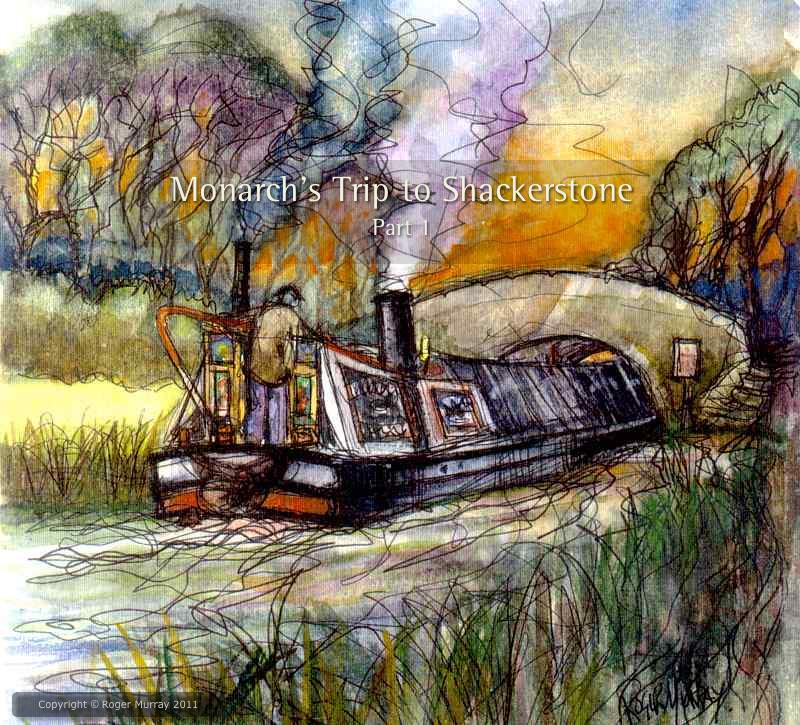


One night in the pub at Bollington, Pete Neville who was Monarch's chief unpaid engineer suggested quite out of the blue 'Why don't we take Monarch to the Shackerstone Steam Rally? I've managed a few days off.' After a bit quick of thinking, I reckoned I could also manage a few days, so that was it. The deal was done! It meant we would have to quickly sort the boat out, get some crew, not forgetting provisions like tins of beans, bacon, tomato ketchup, bread, cans of beer etc and be ready to leave the next day, and that was cutting it very fine!
We had steamed her a couple of times to Shackerstone in previous years and it always turned out to be a good do. A very local gathering of traction engines, steam locos, and narrow boats .... And of course...steam boats! In fact the cream of canal steam boating, including us of course! Making the grand fleet of three. Phil Martino with his gallant steamer 'Adamant' and Dr Sean Neil with the magnificent little steam ice breaker 'Laplander' It was a pity that President wasn't going to make, but I suppose she cannot attend every event, and she visits many.
As with most canal gatherings, they are generally held a long way from where you keep the boat, and Shackerstone was a prime example being a good three to four days steaming from Bollington. The problem was now finding crew at such short notice. Did a big phone around that evening, but they were all under domestic orders. So it was going to be just Pete and me.
On the morning of departure we did a bit of polishing as the needle of the big brass pressure gauge slowly crept its way up to 50, then to 100 then up to 200psi of steam. You listen for the reassuring hiss from above the cabin top as the safety valves lift, first one then the other at about 205psi. This time is always accompanied by the familiar sounds of hissing, gurgles, and wet spluttering, not forgetting that special warm steam engine smell of hot cylinder oil. Waking memories of smoky railway stations of long ago. It is an evocative aroma and it's very special.

During this getting up steam period we had been busy wiping and oiling all the moving parts of Monarch's triple expansion steam engine, filling the oil boxes, checking the wicks and at the same time gently introducing steam into the engine to enable it to warm up gradually. Checking the cylinder drain were open the engine was barred over a few times and then let to revolve slowly under its own power.. This is a magical time when the boat awakens from a deep slumber to become a warm living thing.
It never ceases to fascinate me to watch the cranks, piston rods, cams and the myriad of mechanical bits and pieces, all moving in different directions, seemingly at odds with each other yet in complete unison on this wonderful mechanical piece of wizardry of a bygone age. We were now on dry steam, the cylinder drain cocks were shut off, a quick check through all the relevant valves and levers, boiler water level and water feed pump, a blast of the whistle and we were now ready to cast off. Shackerstone bound!
The trip would be a good opportunity to try out the new boiler water feed system which would pump hot water into the boiler instead of cold, in theory cutting fuel costs considerably. Pete had made a special heat exchanger which would feed live steam into a cylinder which cold feed water passed through before going into the boiler. It looked like something out of a nuclear submarine. It would also be a good time to try out our new secret weapon. A big ancient bronze steam injector. Although the boiler water is fed from a high pressure pump working off the engine, it sometimes cannot keep up with the boiler demand, so as a back up we use a steam injector which works on a bit of mystical Victorian black art.

It can actually inject water into the boiler using its own steam pressure, and it works! We had just fitted this monster injector as the earlier one was a bit on the small side and sometimes in an emergency (or panic!) we need to get water into the boiler fast! This was a real antique, so ancient we reckoned it could have come off Stephenson's Rocket, and was reputed to be so powerful it could suck your boots off!
We considered coal firing Monarch to Shackerstone, but being only two handed, Pete and me, it was decided ( as I am inclined to be lazy at shovelling) and with it being last minute and the weather very hot - and to be honest, we hadn't ordered any coal, we opted for the easy option of oil firing. (Monarch can either be oil or coal fired). Then to our dismay on dipping the fuel oil tanks we discovered they were only half full and it would be impossible to get a delivery of kerosene in time for the next day's departure.
The only handicap with oil firing, especially with kerosene is that you can't just fill up from a pump at a boat yard. You have to pre arrange with an oil heating company for a bowser loaded with a minimum of 300 gals to meet you at a pre planned canal side location en route. Even though it was summer when you would think the domestic fuel companies would be desperate to sell oil. It could never seem to be done without three or four days notice. We decided to do a bit of phoning on the mobile en route and try and get some in Rugely or Tamworth. We had a couple of bags of coal on board which could be used as a token coal firing gesture at Shackerstone to convey the right atmospherics with loads of smoke. although it's
surprising how times have changed. Only a few years ago
people used to sniff the air as you steamed past with that
Bisto Kids look of ecstasy, savouring the aroma. Not any
more! The youngsters point at the smoke, put their hands
to their mouths and complain that we are causing pollution.
Even a couple of nuns once had a go at us. Must have been
high tech nuns!


As time was short we had to get off the next day. Pete would join the boat in the evening as he then worked for British Waterways and had been assigned to do some job at Bosley Locks. The plan was to get through Bosley with the help of Max who runs the Adelphi Mill at Bollington and his girl friend Kate who volunteered to come as far as we could get that night. Max could also keep his eye on the boiler and Kate said she would make a curry, which clinched the deal.
I can handle Monarch on my own, but ideally she needs somebody in the engine room to watch the boiler water level glass which is critical and can't be seen clearly from the steering position. She is also a bit of a hooligan to handle weighing over 30 tons and being deep draughted, especially on the Mac, which is shallow. The tiller once broke two ribs of a lady steerer, who wasn't too pleased.
Monarch can be controlled when oil burning from the steering position. There is a repeater steam pressure gauge behind the funnel, so the steerer can watch and control the boiler steam pressure with the burner controls which are also repeated to the stern together with the engine controls, so the steerer can control the boats speed with the steam regulator, can go ahead or astern with the reversing lever, and of course he can blow the whistle, which it is all about! What he can't do is clearly see the boiler water level glass, which is mounted on the boiler down in the engine room, and if it is showing a low level he can't inject water into the boiler without stopping the boat and going down into the engine room. Ideally someone should be in the engine room when the boat is steaming. Boiler water level is absolutely critical on a steamer. Water is constantly being pumped into the boiler under pressure by a mechanical pump which is worked from the engine. It is calibrated to keep up with boiler demand, but it sometimes doesn't. It can get a bit of clag in the pump, so we should at all times know what the boiler water level is and certainly never leave it to chance.

We had cast off from Bollington, and quickly cleared Macclesfield. The boat was fairly tramping along and making good time. Kate had just finished making the curry and Max was in the engine room. I was on the tiller with a mug of tea. Where better to be on this bright sunny afternoon than gently chuffing along through the English countryside on this magnificent old steamer!
The peace was short lived and came to an abrupt stop as we rounded the bend at Dane Bank just south of Macclesfield. I noticed the swing bridge we were passing rapidly coming towards us. It slammed into the side of the boat with an almighty clang as the prop picked up and wound the chains and bridge bar tight against us. Everything was locked solid. If anybody had been walking along the gunnels it could have caused a very serious accident, certainly could have taken their legs off.
To our disgust the impact knocked Kate's curry off the top of the boiler!
We managed to bar the engine over in reverse (remember we have no gearbox!) and gradually loosen the tension on the chain. The difficulty was that we could not get a big enough gap between the boat and the bridge to get at anything, and of course it was all under water. After a lot of effort and time we finally managed to undo the shackle pins just as British Waterways turned up in the form of Pete Neville all dressed in green. Between us we managed to finish the job waist deep in water getting the chain off the prop shaft. The set back really knocked us back on time, so we got a head of steam up and made for the top of Bosley locks where we had a good evening on Kate's magnificent curry mingled with a slight flavour of steam cylinder oil washed down by a few cans of beer.

Next morning it was steam up, a quick breakfast of curry sandwiches and a slow transit down the twelve locks. Every boat on the system seemed to be trying to get through Bosley. Then it was full steam ahead, trying to make up for lost time to the Harecastle Tunnel. We had only been steaming for about half an hour, she was fairly tramping along like a Black Five when there was some horrible clunking and banging coming from the back of the boiler accompanied with an abnormal amount of steam. It sounded very ominous. It was Pete's new water feed heat exchanger which was so efficient that it was turning the feed water into steam before it entered the boiler. Fixing it took another three hours helped by many mugs of tea and bacon butties. The final solution was by Pete boring a pin sized hole in a 10p coin which just fitted into the steam feed, thus reducing considerably the amount of steam entering the heat exchanger. It worked like a dream. Who'd believe a pin hole of steam would heat water being delivered at hundreds of gallons an hour?
Going through the Harecastle tunnel on a steamer is like something from Dante's Inferno. There is so much steam you can't see a thing ahead so it is difficult to keep the boat oriented in a straight line. The heat from the funnel brings down all the spiders, thousands of them hanging on their threads, the whole cabin top moves with them; you can feel them round your ears and down your neck. Someone in the engine room has to constantly yell the boiler pressure and water level so that the steerer knows how much steam and power he has, and towards the middle of the tunnel where the roof gets low we have to drop the funnel, it's then a matter of bending down and peering along the cabin sides at nothing but steam and trying to steer. It's even worse north-bound as the fans are drawing all the steam into your face. It's quite theatrical as the close confines of the tunnel and its special acoustics seem to amplify all the sounds, especially the barking steam exhaust giving the impression of going much faster than you really are. You can imagine you are behind some massive ghostly loco thundering through the night. This grandiose illusion ends abruptly as you emerge from the tunnel entrance at a slow three miles an hour covered in spiders.

We gave a few blasts of the whistle as we passed Stoke on Trent Boat builders who had painstakingly worked on Monarch for two years when she was converted back to steam in 1990. Mike Atkins as always, comes out and gives a wave. I could never work out whether it was out of affection for the old girl, or thinking Thank god she's not still here! We then moored up by the bridge to go and purchase a large traditional brown teapot from what is reputed to be the last firm still making them. Monarch isn't the same without it's large brown teapot. The last one broke when the swing bridge hit us!
The Potteries were soon cleared and we got down to a good routine. Pete had now joined and was down in the engine room attending to the hard working triple expansion engine's needs. The weather was scorching hot, certainly not the weather for a steam boat. It was like being in a Chinese Laundry down in that engine room. The peace was shattered again, this time by a tremendous whooshing noise followed by clouds of steam and everything which was loose seemed to rattle. Pete's voice yelled from below. 'F.. me. That's some bloody injector!' He had been giving the new monster injector its first trial. I glanced at the steam pressure gauge. It was dropping. If you pour cold water into a boiling kettle it stops boiling. The same happens with boilers. Apart from the cooling effect, such a rapid ingress of cold water can't do much for the boiler.' Turn the bloody thing off' I yelled and the whooshing stopped. I could just see Pete's eyes through the steam. 'It's emptied the whole of the holding tank in one go', he yelled. 'Think we'll put the old one back on tonight, or see if we can modify it's flow a bit'. It took us the next mile or so to get back up to a full head of steam again.
We were passing the same spot just past Trentham where a few years previously, big Pete Askey who was with us at the time, shouted that he thought he saw a dead horse in a field. We slowed the boat down and could see a big black horse lying very still on its side with another horse standing looking down at it. We both nobly agreed that we should check if it was okay.

Monarch was nudged into the bank and we managed to get over the fence and through some bushes and nettles and amble gingerly over to the dead horse. The one standing next to it shot off at a gallop and the dead one suddenly became very much alive, rapidly got to its feet and started to chase us with its lips back barring its teeth...and it was some big black horse! On diving back through the bushes a diminutive girl appeared on the towpath carrying horse tack shouting that we had no right to interfere with her horses. Pete gave a knowing smile and suggested that it was a good opportunity to have a mug of tea and oil the engine.
When the previous owner converted Monarch back to steam, in his wisdom he installed a marine triple expansion steam engine. His first intention was to have a specially built, a replica of the original tandem compound engine which was used in the Fellows Morton Clayton steamers. Unfortunately there were no existing drawings available, and they had a reputation of stalling on top dead centre when going astern. Which isn't very encouraging when meeting other boats in bridge holes. He decided to go for the well tried and trusted marine triple expansion engine which went from ahead to astern with ease.. Nearly every dirty old tramp steamer plying the oceans of the world from the turn of the century until the Second World War relied on the trusty triple. Even the Titanic had one! This was inclined to be a big engine for a narrow boat; (not the Titanic's) She is a bit overpowered, which isn't a bad thing. At normal cruising speed she is only be doing about 90rpm swinging a massive 32inch prop, which is inclined to paddle the boat sideways until she makes way and makes manoeuvring difficult. At one stage we thought of running two steam pipes forward and having them just below water level on either side of the bow. Would have made a spectacular bow thruster.
On most vertical steam boilers there is a blow down valve. This enables you to blow out at steam pressure, all the gunge which accumulates in the bottom of the boiler. You are supposed to do it two or three times a day, especially if you are none condensing and using canal water in the boiler. On Monarch the blow down came out of a hole on the starboard side of the hull.

When you opened the blow down valve an enormous jet of steam together with the gunge was directed at the canal bank. It is very spectacular as it is accompanied by a big roar. When we wanted to blow down, whoever it was in the engine room shouted up to the steerer, 'OK to blow down?' The steerer checked that the bank or tow path was clear and shout back. Ok! We were steaming along near Sandon when it was shouted up 'Ok to blow down. I checked the towpath. It was clear ahead but there was a middle aged man standing with a dog abreast of the boat. I waited until we were well clear of him and then shouted back ok! The jet of steam blasted out of the side of the boat completely engulfing some bushes. There was a scream and a hysterical woman came running out dripping wet with her knickers round her knees. The man with his equally hysterical barking dog threatened to thump us for compromising his wife. All ended well. We stopped under a bridge hole and gave them both a coffee. He couldn't stop laughing, saying he would remember it for the rest of his life. She was not really amused. We used to have a lot of fun with that blow down. It was our secret weapon especially with haranguing fishermen.
There is the special art in maintaining enough head of steam whilst navigating the boat.. If you've been watching the scenery too much, not keeping an eye on the pressure gauge and let the steam pressure go down. When you urgently need to slam her astern, as happens in bridge holes and things. Little happens, it's like having a wet Haddock as a prop. You also have to constantly keep a critical eye on the boiler water level. If the water level drops as it does, you have to inject more water into the boiler which unfortunately cools it thus reducing steam pressure. To get steam pressure up you have apply more heat to the boiler. If you are coal firing and lob on more coal, unless it is done skilfully you can dampen the fire down and lose more heat, thus steam. It's juggling act and needs concentration, but very satisfying when you have got all the elements right. How those drivers and firemen of the express steam trains managed to keep a constant head of steam travelling flat out all the way from London to Glasgow I shall never know.




